Comparison guide
Cabinet painting vs replacement: which fits your kitchen
The choice between painting, refacing and replacing cabinets comes down to the boxes. Sound boxes can take paint; damaged ones can't, whatever the finish looks like.
Questions about your own house? We answer 24/7.
By Carla Bingham, Painting and Restoration Guides Editor · Updated September 2026
Quick answer
Cabinet painting usually makes sense when the boxes are solid and dry and the layout works. In Atlanta market data, painting averages around $1,000 in one survey and $8,000 to $12,000 for large kitchens in another, while replacement runs $15,000 to $50,000. Refacing sits between, averaging about $7,032. Water-damaged or particleboard boxes point toward replacement.
The three options and what they cost
Painting keeps your boxes and doors and changes the color and finish. Refacing keeps the boxes but adds new doors, drawer fronts and a veneer over the frames. Replacement removes everything and usually brings new counters with it.
Published Atlanta figures show how far apart they sit. One local cost survey puts cabinet painting around $1,000 on average; a local painting company puts large kitchens at $8,000 to $12,000 and replacement at $15,000 to $50,000, noting that painting saves 50 to 70 percent. HomeAdvisor's Atlanta data puts refacing at an average of $7,032, typically $3,904 to $11,502.
| Option | What changes | Published Atlanta range |
|---|---|---|
| Paint | Color and finish | About $1,000 average; $8,000 to $12,000 large kitchens |
| Reface | New doors and veneer | Average $7,032; typical $3,904 to $11,502 |
| Replace | New boxes, doors, usually counters | $15,000 to $50,000 |
When painting is the right call
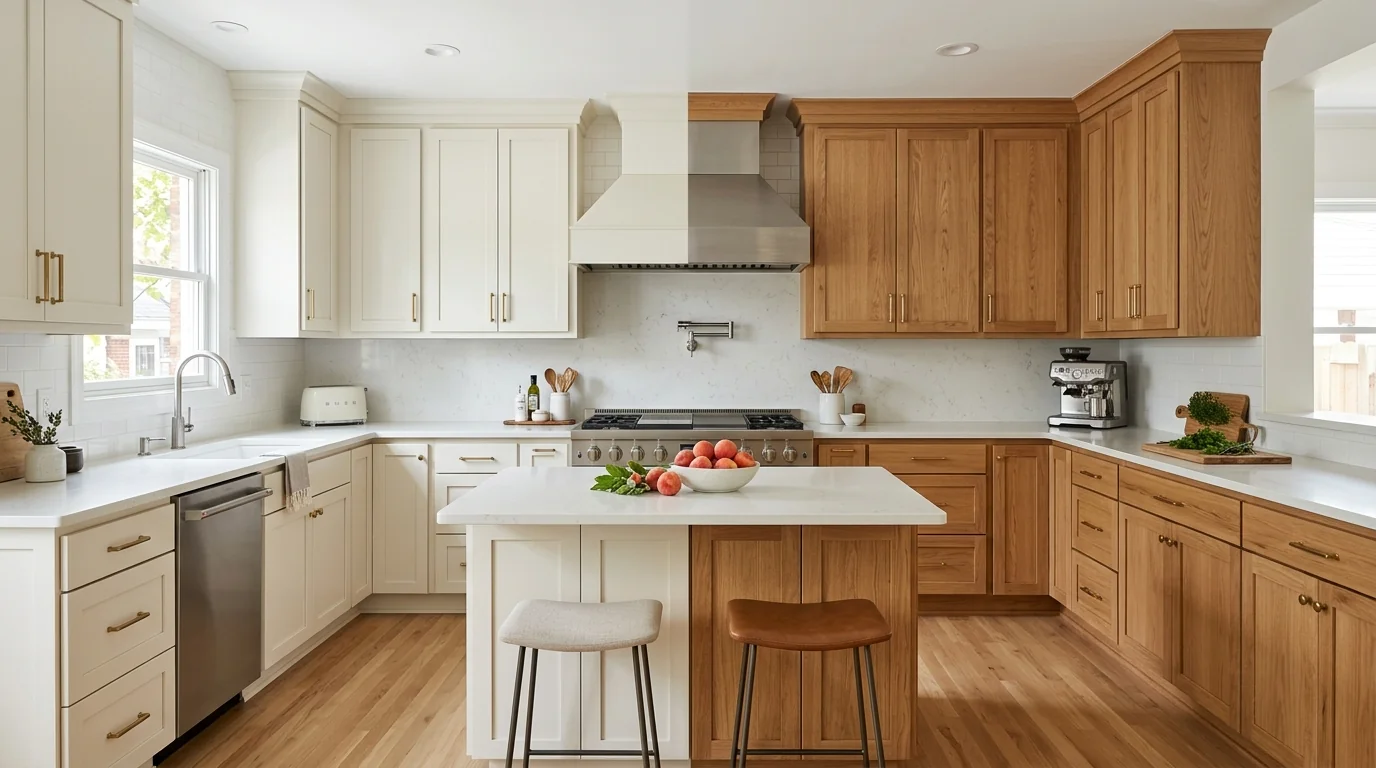
Painting works when the cabinet boxes are plywood or solid wood, dry and square, the doors close properly and the layout suits how you cook. Dated oak, tired white and builder-grade finishes all paint well with the right prep.
It also suits kitchens where the counters are recent or in good shape, since painting doesn't touch them. Pair it with new hardware and a backsplash and most people stop noticing the cabinets were ever old.
When it isn't
Swollen particleboard under the sink, delaminating thermofoil, sagging shelves and boxes that were never square are problems paint can't fix. The same goes for a layout that doesn't work: painting a kitchen you want to rearrange only delays the remodel.
Look under the sink and around the dishwasher first. Georgia humidity and years of small leaks show up there before anywhere else, and they often decide the question.
What a proper paint job involves
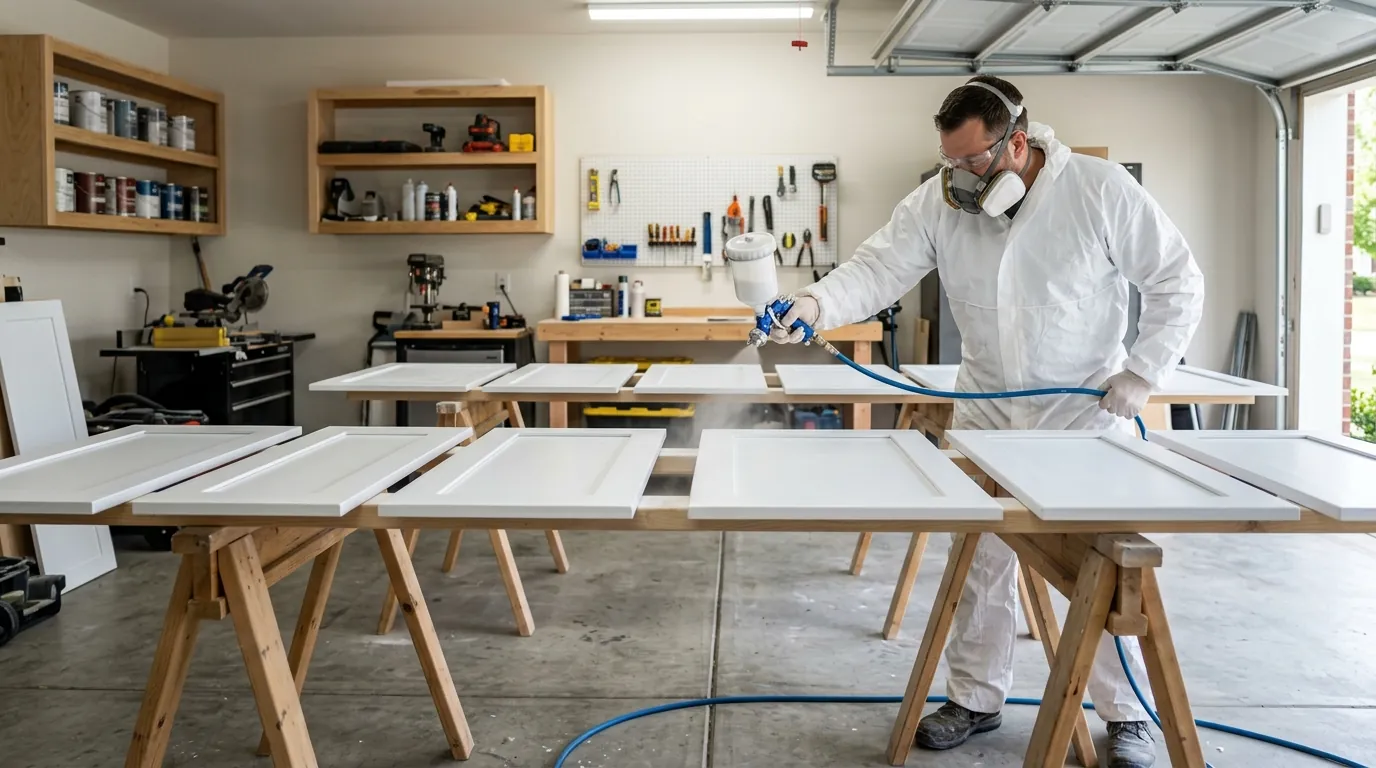
Doors and drawer fronts come off and are labeled. Every surface is degreased, sanded and primed with a bonding primer, then sprayed with a hard cabinet enamel. Boxes are painted in place with the kitchen masked off, and doors cure before they're rehung.
Most failures come from skipped degreasing or the wrong primer. Kitchen grease is invisible and paint won't bond to it, which is why DIY cabinet jobs so often chip near the stove within the first year.
Choosing a color and finish that wears well
Cabinet enamels come in satin and semi-gloss. Satin looks softer and hides small dings; semi-gloss wipes cleaner and shows every brush mark or dent, which is why it's sprayed rather than brushed. Most kitchens look best in satin.
Very light whites show grime near handles, and very dark colors show dust and scratches. Mid-tone greens, blues and warm grays hide daily wear best. Test a color on one door in your own kitchen light before painting the rest, since cabinet colors look very different under warm bulbs than on a sample card.
Where refacing fits
Refacing makes sense when the boxes are sound but you want a different door style, from raised panel to flat slab for example, which paint can't change. It costs more than painting and less than replacement, and the kitchen stays usable through most of the work.
A quick way to decide
Ask four questions in order:
- Are the boxes dry and solid, especially under the sink?
- Do you like the layout?
- Do you like the door style?
- Are the counters staying?
Yes to all four points to painting. No to the door style points to refacing. No to the first two points to replacement.
Questions
Cabinet painting vs replacement questions
When the boxes are sound, usually. It costs a fraction of the $15,000 to $50,000 replacement range in Atlanta data.
With proper degreasing, bonding primer and a cured enamel, many years of normal use.
Dry, intact particleboard can. Swollen or crumbling particleboard can't be saved with paint.
Only if you want a different door style. Otherwise painting costs less for a similar result.
Yes, when they are degreased, primed with a bonding primer and finished in a cured enamel. Skipped prep is what causes chipping.
Yes. Painting and refacing both leave counters in place.
Related
Services this guide covers
More guides
Keep reading
What Interior Painting Costs in Atlanta, GA
Room and whole-home ranges, hourly rates, and why older intown houses cost more.
our interior painting cost guideRestoring Original Woodwork in an Older Atlanta Home
How to tell whether stained trim needs cleaning, recoating or stripping.
our woodwork guideHow to Choose a Painting Contractor in Atlanta
What a good quote lists and the questions worth asking.
our hiring guideFind out what your cabinets can take
Call and we'll check the boxes before recommending paint, refacing or replacement.
Call (470) 887-8741Answered 24/7 from 565 Tift St SW Ste b, Atlanta.
Where we start from