Cedar siding and shake staining
Cedar siding and shake staining for Atlanta homes
Cedar is beautiful stained and miserable painted over badly. Stain keeps the grain, lets the wood breathe and wears away gently instead of peeling in sheets.
Calls answered 24/7. Crews staged from the Atlanta service office.
- Answered 24/7
- Cleaned and brightened first
- Penetrating stains
Quick answer
Staining cedar siding and shakes in Atlanta means cleaning off gray fibers, mildew and old finish, brightening the wood so the grain opens, letting it dry fully, then applying a penetrating stain from lines like Cabot, Sikkens or TWP. Timing matters: pine pollen from mid-March to early April sticks to wet stain, so we schedule around it.
Updated September 2026
The job
Why cedar is stained rather than painted
Cedar holds natural oils and moves with humidity. A film-forming paint fights that movement and peels; a penetrating stain soaks in, protects against water and sun, and fades gradually so recoating is simpler.
We clean, brighten and dry the wood, then apply stains such as Cabot, Sikkens, TWP or Armstrong-Clark, back-brushing them into the grain and the ends of every board and shake.
What is included
What a cedar staining job includes
- Inspection of finish and damaged boards
- Low-pressure clean with a wood cleaner
- Brightener to restore color
- Replacement of split or rotted pieces
- Full drying time before stain
- Stain sprayed and back-brushed
- Final walk-around and touch-ups
Around Atlanta
Pollen season and cedar staining in Atlanta
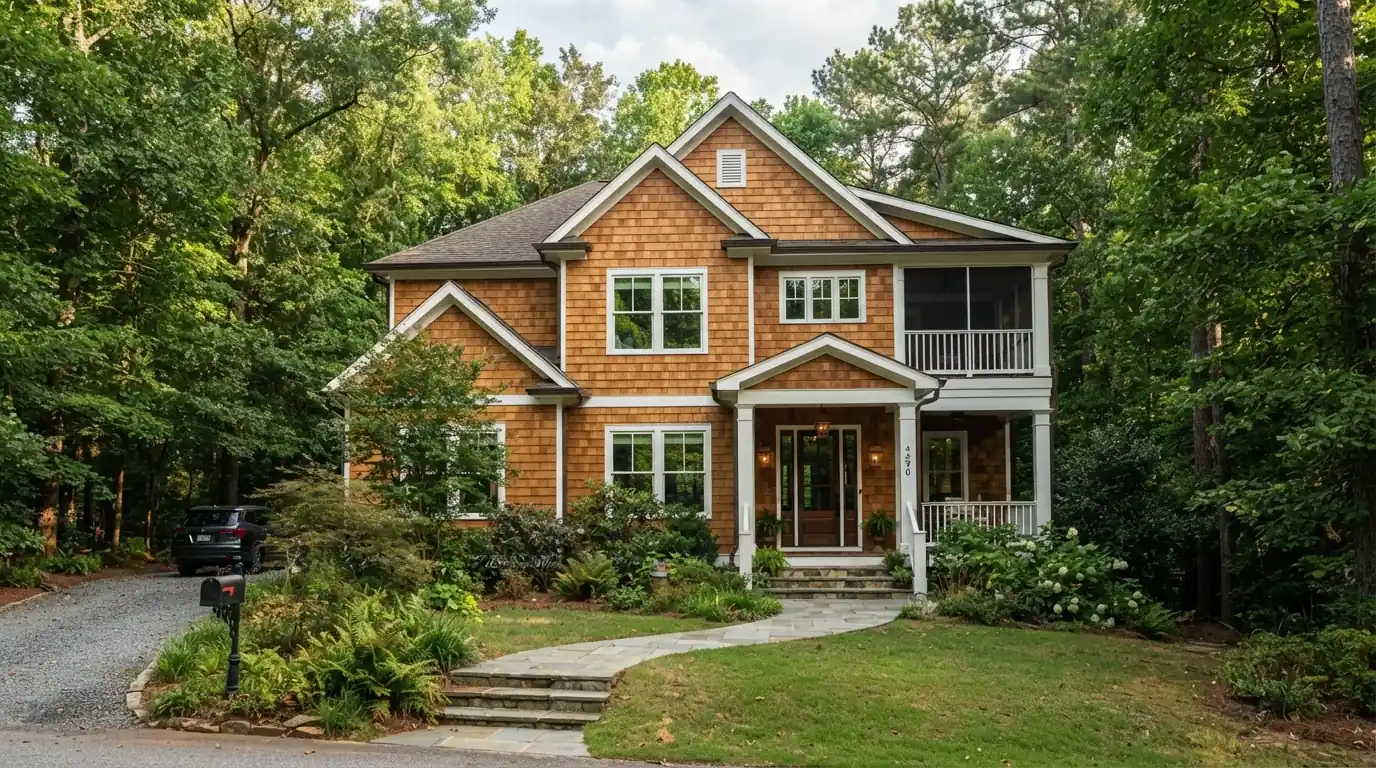
Cedar on Atlanta houses rarely wears evenly. Walls shaded by big trees stay damp and turn gray first, while the sunniest sides bleach and dry out, so one house can need two different treatments. We clean and brighten every wall, then plan the stain around that split, with an extra pass on the elevations that take the most sun and rain, so the whole house wears at a similar pace instead of one side failing years early.
What we handle
Cedar work we stain
Cedar lap siding staining
Cedar lap siding grays within a few years without protection, and its lower edges and butt joints take the most water. We clean the siding at low pressure with a wood cleaner, use a brightener to restore the color, and let it dry before staining. Semi-transparent stain keeps the grain visible; solid stain evens out boards that have weathered unevenly or been replaced. Every coat is brushed into the board edges and the joints, where water soaks in first.
Cedar shake and shingle staining
Shakes and shingles have rough, textured faces and hundreds of overlapping edges, so stain has to be worked into every surface, not just sprayed across the front. We clean gently to avoid splitting the thin shingle tips, brighten, dry and then spray and back-brush the stain so it reaches under the butts and into the gaps. Split, cupped or rotted shingles are replaced before staining, since a new coat won't protect a shake that is already failing. Nail heads that have rusted are sealed too.
Log and board-and-batten staining
Board-and-batten siding and log or rough-sawn cedar surfaces absorb a lot of stain and weather quickly on sunny walls. We clean and brighten the wood, check the battens and chinking for gaps, and apply stain in the amount the surface can absorb rather than a fixed coat. Checks and cracks in larger timbers are stained into so they don't show as bare lines. Upper walls and gables are reached with ladders or staging suited to the height.
Stain stripping and restaining
When old solid stain or a film finish is peeling, a new coat on top will peel with it. We strip the failing finish with a wood stripper, rinse, neutralize and brighten, then let the wood dry fully before restaining. It is more work than a maintenance coat, and it is the only way to get a peeling cedar wall back to a finish that lasts. If the house was painted over cedar at some point, we'll explain what stripping would involve before recommending it.
Step by step
How a cedar staining job runs
- 1
Inspect
Finish, damaged boards and moisture checked on every wall.
- 2
Clean and brighten
Wood cleaner, brightener and a gentle rinse.
- 3
Repair and dry
Damaged pieces replaced, then drying time.
- 4
Stain
Sprayed and back-brushed into faces, edges and ends.
- 5
Review
Every wall checked with you and touched up.
Coatings and materials we work with
Your options
Choosing a finish for cedar
Three finishes for cedar siding and shakes, and how each one ages.
| Finish | Look | How it wears | Recoat |
|---|---|---|---|
| Semi-transparent stain | Grain visible | Fades gradually | Clean and recoat |
| Solid stain | Opaque, grain texture | Can peel if built up | Clean, spot strip, recoat |
| Clear water repellent | Natural wood | Grays in sun | Most often |
What moves the price
What moves the price of cedar staining
- Wall area and height
Two-story walls and gables need ladders or staging.
- Shakes or lap siding
Textured shakes take longer to coat thoroughly than lap siding.
- Old finish condition
Peeling finish has to be stripped first.
- Damaged boards
Split or rotted pieces are replaced before staining.
- Stain type
Semi-transparent and solid stains differ in coats and material.
- Trim and details
Windows, corners and fascia add brush work.
Questions
Cedar staining questions
It depends on sun and stain type; sunny walls wear first, and semi-transparent stains need recoating more often than solid.
Only after the paint is stripped, which is a larger job.
Semi-transparent shows the grain; solid evens out weathered or replaced boards.
Sunlight breaks down the surface fibers. Cleaning and brightening restores the color.
Yes, split or rotted shakes are replaced before staining.
Also in Exterior Painting
Related work from the same crews
- Metal Roof Painting
- Exterior House Painting
- Brick and masonry painting in Atlanta
- Stucco painting and repair in Atlanta
- Deck staining and sealing in Atlanta
Before you book, read our deck finish guide.
Bring the cedar back before it weathers further
Tell us what your cedar looks like now, and we'll set up a visit to check it.
Call (470) 887-8741Answered 24/7 from 565 Tift St SW Ste b, Atlanta.
Where we start from