Interior staircase painting
Interior staircase painting for Atlanta homes
Stairs take more hands and feet than any other painted surface in the house. The finish has to be harder, the prep more careful, and the work planned so you can still get upstairs.
Calls answered 24/7. Crews staged from the Atlanta service office.
- Answered 24/7
- Hard-wearing trim enamels
- Stairs usable during the job
Quick answer
Staircase painting in Atlanta is priced like detailed trim work, which local cost data puts at roughly $2 to $6 per square foot on top of ordinary wall painting. Balusters, newel posts and risers are brushed by hand in a hard trim enamel, and we paint alternating treads so the stairs stay usable. A walk-through sets the scope and colors.
Updated September 2026
The job
What goes into painting a staircase
A staircase has dozens of small surfaces: risers, stringers, skirt boards, balusters, handrail, newel posts and sometimes treads. Each is sanded to take new finish, filled where dented and primed where bare.
Painted parts get a hard trim enamel such as Benjamin Moore Advance or Sherwin-Williams Emerald Urethane, which levels smooth and resists scuffs. Stained parts are finished with Minwax or Bona products chosen for foot traffic.
What moves the price
What moves the price of painting stairs
- Number of balusters
Each one is brushed by hand, so count drives the labor.
- Paint, stain or both
Two-tone stairs need separate prep and careful lines.
- Tread refinishing
Sanding and sealing treads adds floor-finish coats and dry time.
- Old finish condition
Peeling or heavily built-up paint may need stripping first.
- Profile detail
Turned balusters and paneled newels take longer than square stock.
- Stair height and landings
Two-story stairwells need planks or ladders set on the steps.
Atlanta market range from a published local cost guide, not our price: Atlanta interior painters charge $20 to $90 per hour; cabinetry, textured walls or ornate trim add about $2 to $6 per square foot.
What we handle
Stair parts we paint and finish
Stair riser and stringer painting
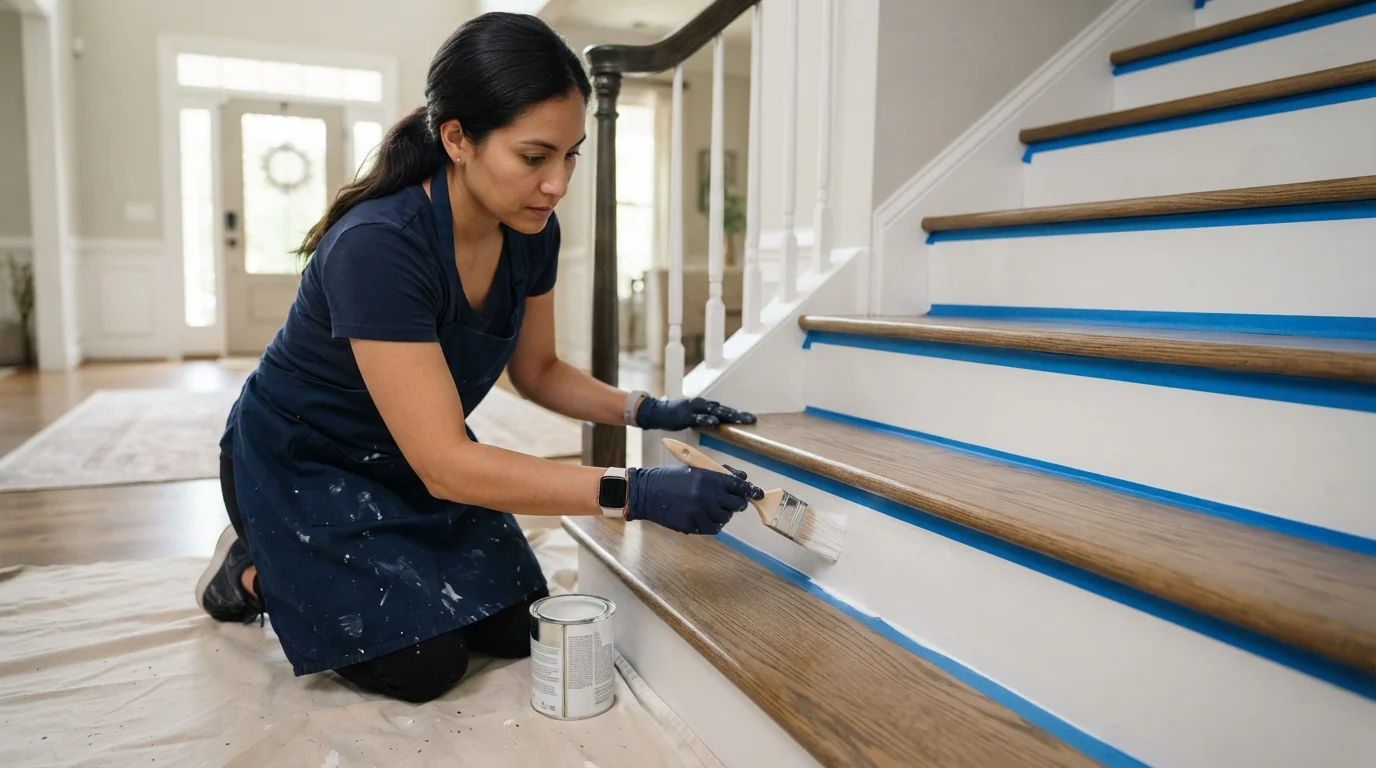
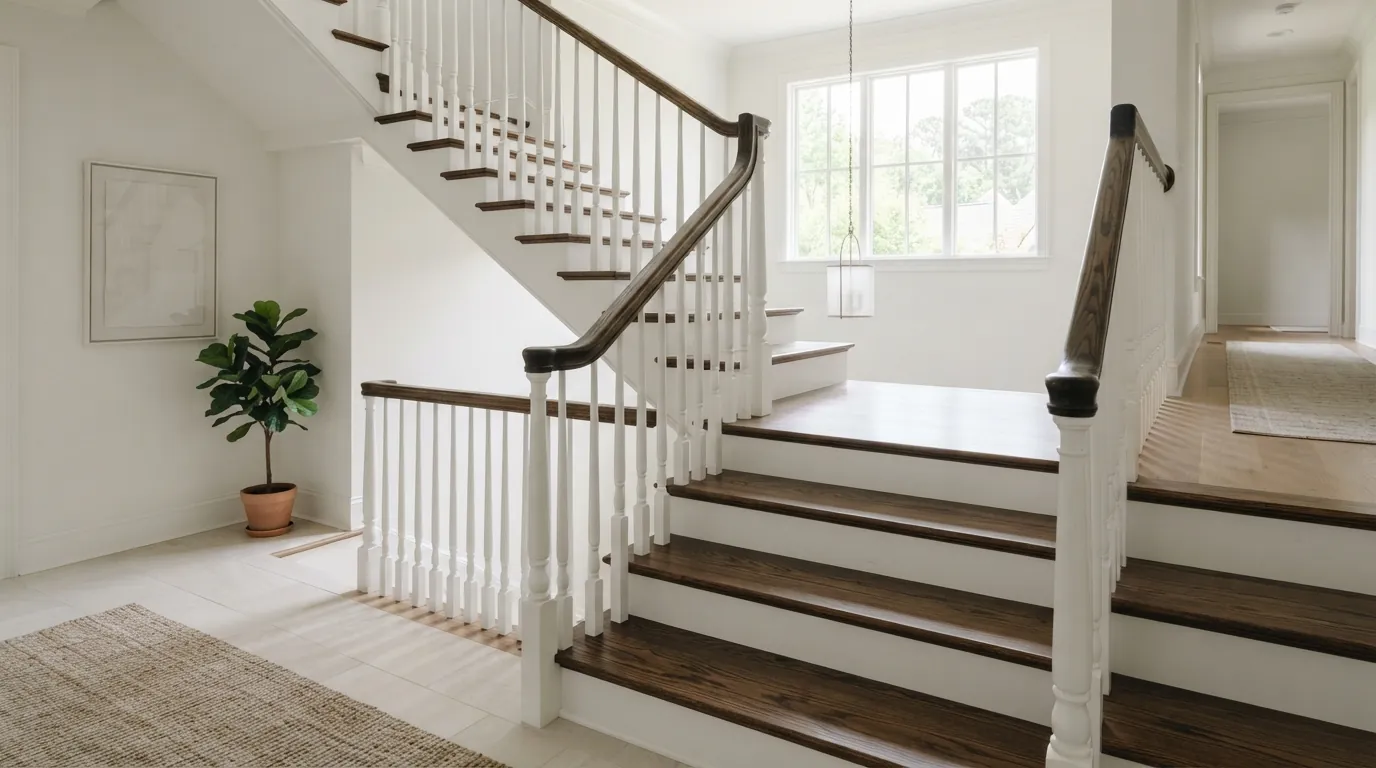
Risers and skirt boards take the most scuffing from shoes and vacuum cleaners, which is why white risers look tired so quickly. We clean off the grime, fill dents and gaps with caulk where they meet the treads, sand the surface to dull the old sheen and prime any bare wood. Two coats of trim enamel follow. Painting risers white with stained treads is the most requested combination, and the crisp line between them is cut by hand, not taped.
Handrail and baluster painting
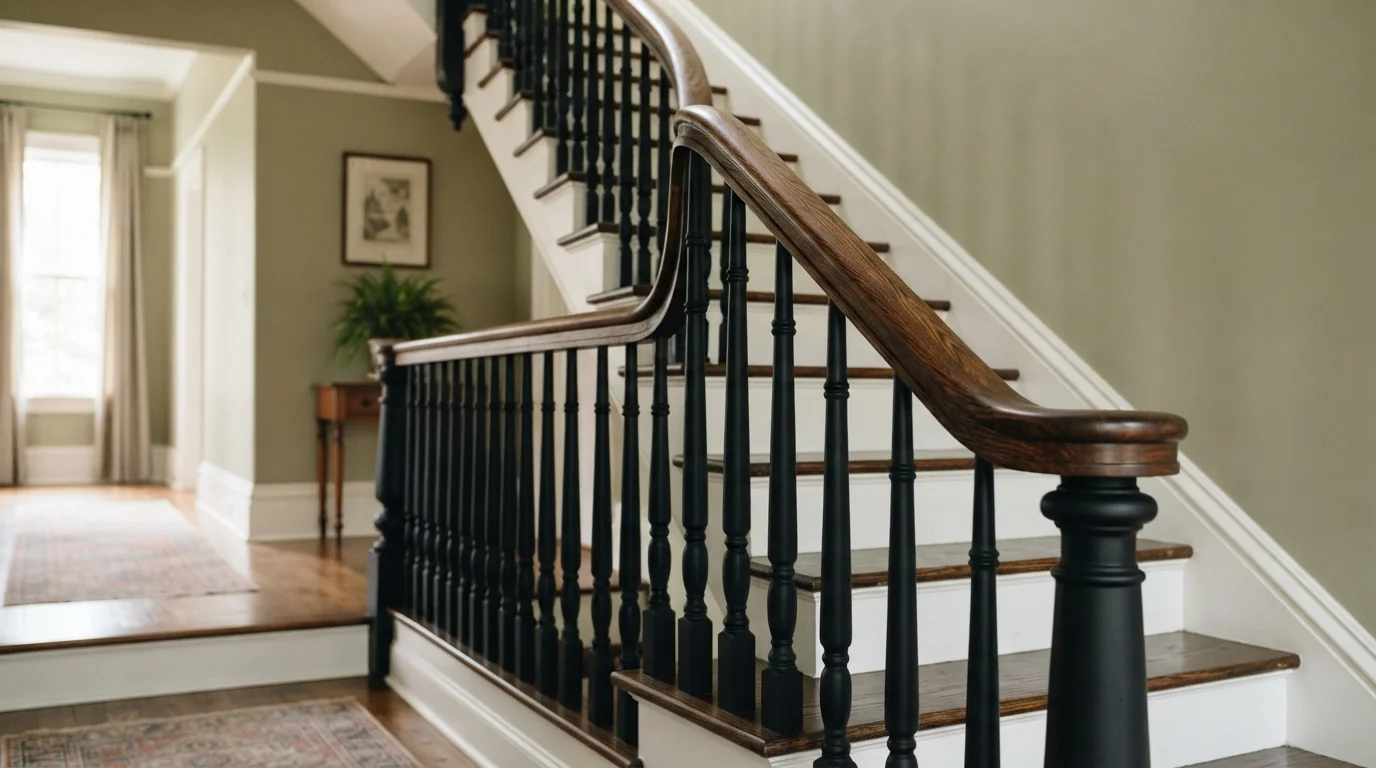
Balusters are the slowest part of any stair job, because each one is brushed by hand on every side and the profile has to be sanded before paint will stick. Handrails take skin oils and grip every day, so they are degreased, sanded and either painted in enamel or stained and top-coated in a clear finish that won't get sticky. Changing oak or dark balusters to white or black is one of the fastest ways to update an entry, and it's done without replacing anything.
Stair tread staining and sealing
Worn treads are sanded back to bare wood, stained to the color you pick and sealed with several coats of a floor-grade clear finish. Stair treads see concentrated wear at the nosing, so the finish has to be a floor product, not furniture varnish. We stain and seal treads in two passes, alternating steps, so one half of the staircase is always walkable while the other dries. Carpeted treads can be exposed and refinished too if the wood underneath is in good shape.
Newel post refinishing
The newel post anchors the look of a staircase and usually carries the most wear and the most detail: caps, chamfers, recessed panels and turned profiles. We sand and fill it carefully, since every flaw shows on a piece that sits at eye level in the entry. It can match the balusters, match the handrail, or take a contrasting color. If the post is loose, we tighten it before any finish goes on, because a wobbling newel will crack new paint at its base.
Around Atlanta
Staircases in Atlanta's older homes
Some of the most involved stairs we finish are in the larger historic houses around the edge of Grant Park, where original staircases carry turned balusters, paneled newels and several generations of paint. Detailed trim in older Atlanta homes like these runs 20 to 40 percent higher in labor than a plain modern stair, because every profile is sanded and brushed by hand. It's also where careful stripping matters most before new paint goes on.
Coatings and materials we work with
What is included
What a staircase job from us includes
- Floor and wall protection at the stairs
- Cleaning and degreasing of rails
- Filling, caulking and sanding of every part
- Bonding primer on old varnish or bare wood
- Hand-brushed trim enamel on painted parts
- Stain and floor-grade clear coat on treads
- Final touch-up and cleanup
Step by step
How a staircase job runs
- 1
Walk-through
We count parts, check the old finish and agree on colors.
- 2
Protect
Floors at the top and bottom covered, walls taped along the stringers.
- 3
Prep
Clean, degrease, fill, caulk and sand every surface.
- 4
Prime and paint
Primer on bare wood, then trim enamel brushed by hand.
- 5
Stain and seal
Treads finished in alternating passes so the stairs stay usable.
Questions
Staircase painting questions
Yes. Treads are finished on alternating steps, and painted parts are dry to the touch within hours.
A hard trim enamel, or stain under a durable clear coat. Wall paint stays soft and gets sticky.
Yes, after cleaning, sanding and a bonding primer so the paint grips the old finish.
Stained and sealed treads wear better. Painted treads show scuffs quickly at the nosing.
Yes, and refinish the treads if the wood underneath is sound.
Also in Interior Painting
Related work from the same crews
- Wallpaper installation in Atlanta
- Stained trim refinishing
- Living room and bedroom repaint
- Bathroom vanity painting
- Interior door painting
Before you book, read restoring stained trim.
Give the entry a staircase that looks finished
Tell us what the stairs look like now and what you want, and we'll set up a walk-through.
Call (470) 887-8741Answered 24/7 from 565 Tift St SW Ste b, Atlanta.
Where we start from